
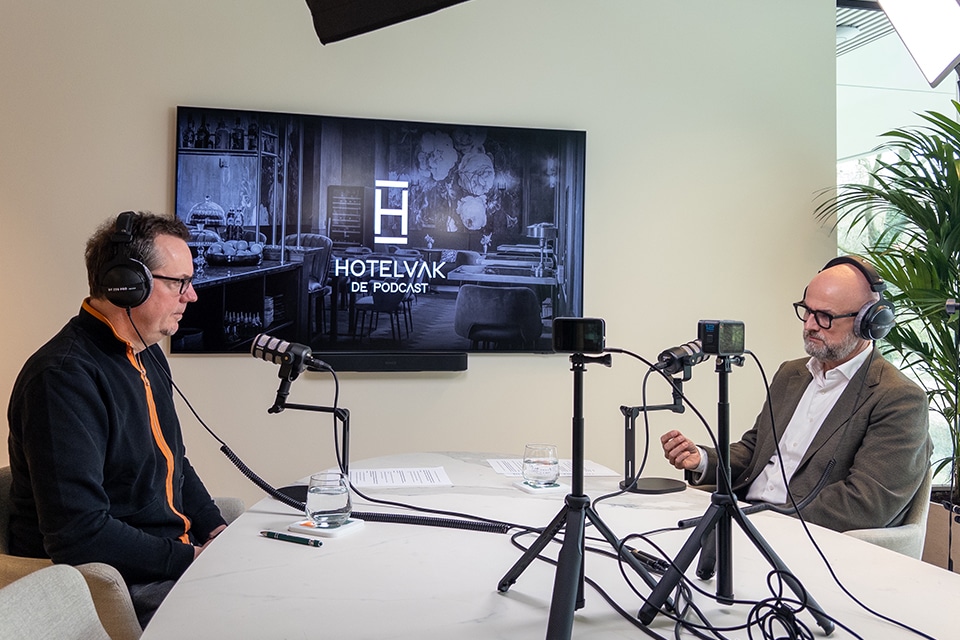
[00:03] Introduction of the podcast and guest
Kris Vandekerckhove: Welcome to Hotelvak, the podcast. Here we talk to people who are shaping the hospitality sector. From owners and investors to developers and innovators. We focus on what is really changing. Technology, business models, real estate and guest experience. So, no buzzwords, but insights and experiences from the field. Mandatory listening for anyone who is professionally involved in hospitality with heart and soul. And who better than Joeri Beusen can we let speak today for that. Welcome.
Joeri Beusen: Thank you. Thank you for the invitation. Good afternoon, my name is Joeri Beusen. I have been in the hotel industry for just under 27 years now. I started as a night receptionist in a Holiday Inn Express once in the very distant past, in 1999. I didn't do any hotel management before that, I rolled into it by chance. From Holiday Inn Express I went to Conrad Brussels, originally again as a shift leader at reception, then reservations manager in a hotel. From there, there was a merger with Hilton Hotels and Conrad Hotels and I went to Hilton Brussels City as a yield manager in charge of business development. In the hotel sector, as everyone knows, there the titles are longer than the business card in a lot of cases. From there, I went to the Amigo Hotel in Brussels of the Rocco Forte Collection as corporate sales and then I went to my next post to Sandton Brussels Centre in Parochiaansstraat as general manager. That was my first position as general manager of a hotel and there I also got to do the opening of the hotel at the same time. There I realised that what I did for other people I might also do better for myself, so I also started on a self-employed basis. Originally I took over some hotels together with a partner, we set up Mond Hotels and from there so it took one and a half, two years and from there I actually became a hotel consultant. What I've actually done since, let's say, 2011-12 approximately, I've helped start up hotels, development, interim management, general management I've done. Mainly Benelux, let's say, but also beyond. Germany, France, up to and including Seychelles at one point, developing hotels. So that's a phrase that did happen. A few years ago, I was asked by one such partner, Hamilton Hotel Partners, to run two hotels in Hasselt, Holiday Inn and Holiday Inn Express. I did that for them, on an interim basis at the time. And about three years ago, Accor Hotels asked me to actually become the developer for the hotels in the Benelux with them at that time. On a franchise basis and management contracts. I did that until this year, January. At the same time, during the period that I was actually really working on a self-employed basis, I was also co-shareholder of Charme Hotels Belgium and Luxembourg and Hampshire Hotels together with Bart Wijnants, the founder of Management Hotels as well. And last year we also bought into Cocoon 7, a four-star hotel in Merksplas, which now, this year, opened in February. We opened on Friday, February 13, with 43 rooms. And that's where we are at the moment. So now at this moment we are also working back on a new independent basis as a consultant for a lot of, as you just said in the beginning as well, the partners who can sit around the table at a hotel.
[03:44] What keeps a hotelier awake at night?
Kris Vandekerckhove: Brilliant, Joeri. You've been steeped and roughed up by hospitality. So this will be an interesting conversation. Right, let's start with a deceptively simple question. What really keeps a hotelier awake at night today?
Joeri Beusen: There are a few things that he definitely doesn't lose sleep over. And those are mainly the service given in a hotel, which he has complete control over himself. Everything around that, from the services, etcetera, etcetera, he has complete control over that himself. The premises he's in, let's say for 99% or some technical stuff here and there, he has complete control over that. But what is not under his control, which is in several things at the moment and that is obviously number one anyway is the economy. So much is happening there and there can be a certain event in the morning where you already feel. I just say, looking back a few years ago also, when the attacks were in Brussels. Attacks happen, by noon I think half the hotels were empty again because everyone got scared and the cancellation started. Anyway, there are Iran right now as well, what is happening there? Just once someone there on the other side of the water has to take a decision of we're going to do something on the other side of the world and the whole world immediately feels about this. So that really does have big effects. Customer behaviour, guest behaviour, is a very big issue right now as well. Guests are super informed right now because they also know what is happening in hotels and how to get that information. They are going to search for the reviews themselves. AI on that front, the hotel owner gives a lot of info, but the hotel guest also gives a lot of info. So he can respond to that. So those are things that can make a lot of changes very quickly. And that's where the hotel owner or operator really lies awake at the moment.
[05:42] Geopolitics as a factor
So geopolitics mainly, I would think?
Joeri Beusen: Absolutely.
[05:46] Second question: dichotomy in the sector
Kris Vandekerckhove: Okay, good. Then we'll go into more depth. You outline a sector that splits between fully automated and human luxury. Why do you see precisely that divide emerging?
Joeri Beusen: That's a very broad story of course. Fully automated, I think at the moment, you have one star up to five stars. The mid-range which is going to have a very difficult time. And that has to do with budgets. If you look at the budget hotels there are now, the two stars, the three stars, so to speak, they make huge savings in terms of staff. So fully automated, everything is automated from pricing policy to room check-in. Everything, everything is there to make savings. So that also remains affordable for a lot of people, for companies, for you name it. The people who have the budget to actually travel, they also want to pay for a trip. And there should not be any savings there either. Those hotels are really getting into the personalisation of services to guests. And I think there is going to be a very big split there at some point between the two. The good thing in that is, that both work. I'm quite convinced of that. And that for both is a certain audience and for both there are budgets in that area. In between, those are hotels that are going to struggle. I really do have that feeling. And you can also see that in the reactions that big chains are also starting to get. And how they are also starting to work out their strategy. They are also either going completely for luxury or for fully automated. And that is a very important point and I really do believe that that is where the big...
[07:26] Disappearance of the mid-market
Kris Vandekerckhove: But doesn't a big chunk disappear right in the middle like that?
Joeri Beusen: Yes, absolutely. A very large chunk will disappear there, because, let's say, meetings and events organised around companies will, on the one hand, fall more under "fully automated". Or if they indeed have the budgets, then I think they'll lean more towards board meetings and the like, which will always opt for that personal service where payment can be made for staff, for that more personal approach, that service which is provided. There will really be a big difference. So that middle segment will have it very tough, and I think it's really important for hotels at this moment to make a choice: are we going left or are we going right, and where are we going to focus, and then maintain that focus.
[08:10] Question about the middle
Kris Vandekerckhove: What happens then with the large piece in the middle, because you have that a bit in every sector, that the middle class disappears, but it doesn't disappear, it's still there, but what happens to that then?
Joeri Beusen: I think that disappears into, let's say, the theoretical side as it disappears. Practically, the hotels that are there, I think, will have to make the choice of, okay, fine, either we go towards the personal side, or we go towards... that might be flawed reasoning behind it. It's also not about pure euros in that regard, because there are budgets for both. And I am also convinced that if you look at the side where personal service is provided, you will find very expensive hotels in addition, but you will also have a premium segment that will always continue to exist. Whereas, if you then look at the fully automated side of the story, there too, for meetings and events, for people travelling with families, you name it, that will continue to exist and will remain affordable on both sides, but you will get a mix between the two.
[09:27] Question about AI and technology
Kris Vandekerckhove: Yes, a lot is driven by technology. That's correct. And you also regularly emphasize AI-driven operations. Where do you already see concrete gains today?
Joeri Beusen: I think in every department of a hotel, AI can be used. More than 20 years ago, longer even by now, the pricing policy of hotels has been guided or determined by AI for years, for a decade by now, coming from the aircraft sector. Meanwhile, it is also, okay well, you have those PMS systems of a hotel, they are also going to determine of okay well, we have those people who are in housekeeping today to clean the rooms, the hourly schedules are in there, so we are going to allocate those and those rooms we are going to allocate to those, those and those rooms we are going to allocate to those, so that you actually get the optimal ratios also to the people who are in housekeeping. If you, there are restaurants that work with a reservation system and that actually say per so many people: okay, so many reservations are coming in, we need someone extra in service, someone extra in the kitchen. The same again for in the kitchen. There are kitchens that have everything, everything, everything labelled. There are five chicken fillets in the frig. Three go out and well, then the menu says, two more chicken fillets can be sold. So go on and on. And that exists with everything like that. Check-ins, just the same. About loyalty systems, yes, you can say okay well, I myself also have such, a loyalty system that I then use myself, that says I would like to have a room on a higher floor far from the lift. Yes, those are things that are already known now. The moment you make your reservation, that may very well be that that room is also already allocated in a hotel, high floor, far away from the lift. That goes a long way.
[11:21] Ask for hype
Kris Vandekerckhove: That’s a bit of an in-between question, there’s also a lot of talk about technology and more specifically AI in every sector. What do you think is more of a hype than something that will concretely break through in the hospitality sector? If you have an answer to that.
Joeri Beusen: More of a fad. I think so. You now have hotel systems that often have more to do with building management systems. When you enter, in most hotels until now, you had a small box on the door where you had to insert your key card. People enter the room, insert it, there is someone in the room, electricity off, TV off, you name it, all lights off. Nowadays, you have a sensor that actually measures that. It also measures at night, is there still someone in the room, yes or no. That sometimes has to do with body temperature even, that is still in the room. And not that you are sitting in a room, you are lying still in bed, and at a certain point the electricity still goes out. But that goes quite far. And then I don't know if that personally, or that will provide a lot of added value.
[12:27] Guest context
Joeri Beusen: There are times of course where there is. But it also often depends on how you as a guest come into a hotel at that moment. I'm going to give a very stupid example maybe. But if I'm travelling on business, I've had a very hard day, I've travelled from one hotel to another, I've had meetings, lots of meetings and I arrive at a hotel in the evening. Actually, I don't want to have spoken to anyone at that point. And then I like to do a self-check-in then. And then I do my thing and I go on and I maybe go for something to eat afterwards. But then I actually want to be at peace. That could very well be that I arrive in that same hotel on the Friday evening, all the time in the world, with my family by, with my wife and my son there and then I say now I want to be addressed, now I do want the personal contact. So again, you can have two extremes in the same hotel. And that's something that continues also in the AI systems behind it. So that's sometimes... and that's where I think it becomes difficult for AI systems of okay well, in what capacity does a guest arrive here today?
[13:29] Paradox technology and personalisation
Kris Vandekerckhove: Yes, indeed. So we are followed everywhere and sooner or later you will know that too, of course, indeed. Because you naturally don't want a generic experience, you don't want standardisation. How do you reconcile that with the fact that technology is the catalyst for everything at the moment, virtually?
Joeri Beusen: It always comes back of course to the data out there. AI systems, they also pick up whatever data they get on or get in. Standardisation, and that's something I think a lot of chains are going to struggle with going forward, they are made on standardisation. And you also notice with chains, they realise that very well, the hard brands, let's say, that are with big chains, those are being pushed forward less and less. You used to have at Accor Hotels, at IHG Hotels, you had brands of a Holiday Inn Express, for example, at IHG or an Ibis Budget at Accor. That's what it looks like, not different. And now at this time if you want to attract guests, you will have to have a certain personalisation somewhere, as you move away from that standardisation to show, okay well, that's where we make a difference, that's where we can, that could be a look and feel, that could be a service given and so on. And there, that standardisation that starts there less and less, or it goes out more and more I mean.
[14:51] Experience in budget hotels
Yes, so even those with budgets or those who opt for fully automated, they will always have to add a bit of experience, because otherwise it won't work.
Joeri Beusen: That can be due to certain things locally in the vicinity of a hotel. I'm just saying, if you're in a tourist location, near the Atomium, and in your hotel, well yes, then you have to be able to present certain things, let's say, around the Atomium, in your hotel. But that's personalisation at that moment. And then you can be on a three-star budget, fully automated, but still pick that up. And I think that's the case. And that is something that a lot of brands then, or those big chains, are reacting to. And they say, 'Okay, great, we're going to do what they didn't do before, now we're going to allow certain points from the neighbourhood, or these could be people who have lived in the neighbourhood or still do, you name it. These could be environments, these could even be businesses in the neighbourhood, that they will bring that diversity more into their form with them.
[15:59] Example of local concept
Kris Vandekerckhove: A good example of that, you may or may not know it, is that Ostendian. It's quite a new one, they've really designed a hotel that is rooted in Ostend, so with the people who have lived there and what's going on in the neighbourhood there, that's exactly what you're saying. While that's not ultra-luxury at all, it'll lean more towards fully automated but it does come with an experience, well, the experience of the neighbourhood included. I think they're even going towards that personalisation aspect rather than that, indeed.
Joeri Beusen: They will be fully automated. I must admit, I haven't personally stayed at that hotel yet, and I know the group behind it, and they are very strong in that area. And on the other hand, that personalisation, that also makes it unique in that regard. And I am one hundred percent sure of that. People who like to go there for that reason.
[16:58] Introducing space to value
Kris Vandekerckhove: I happened to be with the designer of that hotel last night as well. And he also said that yes, it's premium, you pay for it too. Is that Mr Balkaan?
Joeri Beusen: Bart Balkaan.
Kris Vandekerckhove: Bart, yes. We know him too. Right, if you then take that further to how hotels are designed and developed today, you arrive at a term that you use, ‘space to value’. What does that mean in plain English?
Joeri Beusen: Space to value, that actually means that in the past, the focus was mainly on the star rating and what you got in return as a guest. Stars were once established because there were systems, the GDS systems, and no photos could be uploaded to them, very little detail could be uploaded, but a star rating was made. Then we would say, okay, your room is 16 square metres, 20 square metres, 24 square metres, and so on.
[00:00] Continuation: meaning of space to value
Joeri Beusen: Now less and less important. People no longer ask how big is my room, they now ask how fast can I be in the city centre, what services are available, what amenities are in the room. More about experience and they start looking more of okay well what can I do from that hour to that hour, what can I eat there, is there any possibility to have a drink after dinner in the bar. That's one thing people are asking about more now. Whether a room is 16 square metres or 30 square metres so to speak, that priority is much less there now at the moment. And that's what I mean by space to value, they start looking more like okay well, how can I valorise that return, the amount they pay, somewhere anyway and that no longer has to do with the square metres that are there. You now have three-star hotels that end up offering a five-star service. That's where you come across more and more. I know some good examples of three-star hotels where I think of okay, wow, nice, that's well done.
Kris Vandekerckhove: We'll talk about that after this podcast, those will be my next travel destinations. Yes, indeed. I already have tips.
[01:05] Question: Labour shortage and the role of technology
Kris Vandekerckhove: But anyway, we've mostly talked about technology, value, and a bit about figures. But a hotel is, of course, more than just bricks and mortar. Ultimately, it's still about people. Not just the guests, but also those who work there. Those who embody hospitality with heart and soul. You mention labour shortages as a structural issue. Will technology solve that? Or do we perhaps need to reinvent hospitality a little as an employer?
Joeri Beusen: I think that brings us back a bit to the story of splitting hotels. You have the fully automated ones, where fewer people are working. And you have hotels where the service is more driven. I recently read an article and they expect in Europe by 2035, between one and one-and-a-half million fewer people working in hospitality than there are at this current moment. That's huge. These people need to be accommodated, so either you go towards fully automated, when you don't need them, or you'll have to pay them extra to motivate them to end up in those service hotels. So you will get a split there. And indeed, you will replace some people, but you will also use the efficiency of those people, who then come to work in the fully serviced hotels, in the most efficient way possible. And I think that's a very important point. But people remain the most important thing in hospitality.
[02:35] Conclusion: need for choice
So according to you, you have to choose. That's what keeps the hotelier awake at night today, I think.
Joeri Beusen: I am convinced of that.
[02:44] Hotels: a perfect concept?
Kris Vandekerckhove: Yes, then we've actually come full circle. Right, then I have a clincher for you. OK. The most difficult question of the day. If you combine all those evolutions, but not just all those evolutions, but also your gigantic experience that you've built up in the meantime, from the very bottom of the ladder, if I could build one hotel concept from scratch again today, what would that look like according to Joeri?
Joeri Beusen: That's a mouthful, will be. I think, honestly, I have the feeling that, and I want to make one small distinction there as well, it depends on in what capacity you go to a certain location or a certain hotel. Are you going there for corporate reasons or are you going there purely for leisure? Or a combination of both. The combination of is bleisure, as they say. But it will be one of those two. For corporate reasons, I would say an urban hotel, three stars plus. Or in that class, budget-wise.
Kris Vandekerckhove: Three stars plus, is that then those legendary hotels meanwhile, that are three stars, but offer five-star service?
Joeri Beusen: Yes, absolutely. Which are affordable and where you can also work on occupancy, from the hotel point of view, but which can indeed make the difference by giving that extra service. On the other hand, I also believe a lot in hotels, there are a lot of people who are business or leisure segment let's say, don't need to be in the centre of a location, but rooms, banquet halls, you name it. There is also something that has changed from before. You have certain travel groups that have also changed, which didn't exist before. A lot more people nowadays who travel alone. You have many people travelling with entire families, where you then have three generations. You have people doing a bigger combination of business and leisure travel. Those are things you can focus on now, any hotel, too. And that's something that at my hotel, where I would then do the ideal combination, I would also start focusing on those new groups of travellers. So I think, personally, I think it's a very difficult one.
Kris Vandekerckhove: Joeri, I'm not happy. No? No, I'm not happy. And why am I not happy? You let the hotelier choose, but you don't choose.
Joeri Beusen: I didn't say it was an easy choice.
Kris Vandekerckhove: I'll ask my question again, but in a different way. You're a fan of your career, which you're still a long way from, of course. You're a fan of your career. And somewhere between sixty and twenty-five, you think, 'I've had enough of it.' I'm going to build one last hotel from scratch, exactly how I want it. What would it be?
Joeri Beusen: In that case, I'll go for ultraservice.
Kris Vandekerckhove: The ultraservice.
Joeri Beusen: Yes, then I want to be at the forefront welcoming guests.
Kris Vandekerckhove: Ah, lovely.
Joeri Beusen: Then I'll be at reception myself.
Kris Vandekerckhove: Will you also, like others do, rummage through the social media of all your future guests to know exactly what they want beforehand?
Joeri Beusen: One hundred per cent for sure. I want to know who is coming into the house so that I can also prepare and that I can adapt to that guest's stay, I would wish.
Kris Vandekerckhove: The real hospitality, that they will never forget?
Joeri Beusen: No, absolutely.
Kris Vandekerckhove: Fantastic. Thank you, Joeri. That was a delightful conversation.
Joeri Beusen: You're welcome. Thank you.
Kris Vandekerckhove: And thank you for being here.
Joeri Beusen: My pleasure, thank you.
[06:48] End of the podcast
Kris Vandekerckhove: Alright, this was Hotelvak, the podcast in the hospitality sector, where we don't just mic up everyone who has something to say, but definitely thoughtleaders, so those who may not decide what the hospitality sector will look like in the future, but who know exactly where the hospitality sector is going. And that was Joeri Beusen.
Joeri Beusen: Thank you.
