hotelvak.be
EN

Platform on hotel management, interior design and design in Flanders
‘Belgium is a bit more well-behaved than the Netherlands’
With its own representation in Belgium, FURNS Street Furniture is taking the next step in its Benelux strategy. The company wants to be closer to the market and guide designers, contractors and developers earlier in the process. According to Technical Product Manager Mathijs van Haren and Sales Manager Belgium Lieven Tilley, this is necessary: demand for high-quality outdoor furniture and integrated greening is growing, but the Belgian market has its own dynamics and pace.
The expansion does not mean that FURNS is setting up a new organisation. The working method remains largely as clients already know it: estimation and engineering in the Netherlands, production of aluminium, weathering steel and fibreglass in Poland, and assembly and logistics from Uden. The difference lies mainly in the proximity. With Tilley as a local point of contact, the company can respond more quickly, be on site more often, and get involved earlier in thinking about material choices and technical feasibility.
In doing so, Tilley explicitly fulfils an advisory role. He guides green roof installers, landscape architects, contractors and developers in the elaboration of plans, from initial sketch to implementation phase. “We do not sit in the designer's chair, but next to it,” says Van Haren. The aim is to look together at what is technically and practically feasible, for example in the case of green walls, roof gardens or integrated planting solutions. Questions regarding load-bearing capacity, irrigation and stability are brought to the table at an early stage.
That is by no means a luxury, because according to Tilley, the Belgian market clearly differs from the Dutch one. Whereas in the Netherlands large-scale and experimental greening is increasingly being applied, Belgian projects are on average more cautious. “The market is a bit more conventional,” he says. At the same time, attention to climate adaptation and water management is growing there too. Requirements for water buffering on roofs, for example, are becoming increasingly stringent, meaning that traditional extensive green roofs often no longer suffice.
In terms of water use and retention, Belgium still lags behind the Netherlands. The reuse of rainwater for irrigation or water retention on roofs is less established there, while the technical and climatic necessity is comparable. For FURNS, this presents an opportunity to apply expertise from Dutch projects and, together with Belgian partners, translate it into local practice.
The new presence is primarily intended to ensure that design teams can brainstorm about solutions earlier and that projects run more smoothly. By being closer to the market, FURNS expects to be able to respond more quickly to questions regarding greening, water retention, and the integration of outdoor space into architecture.
Yalo Urban Boutique Hotel, Ghent
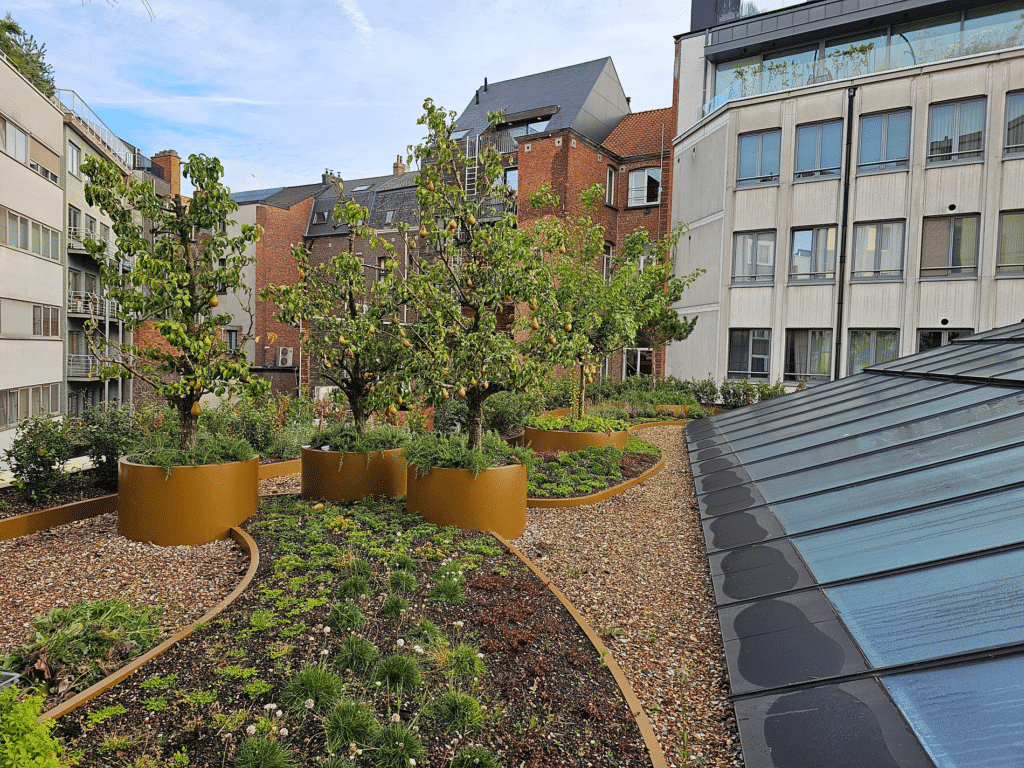
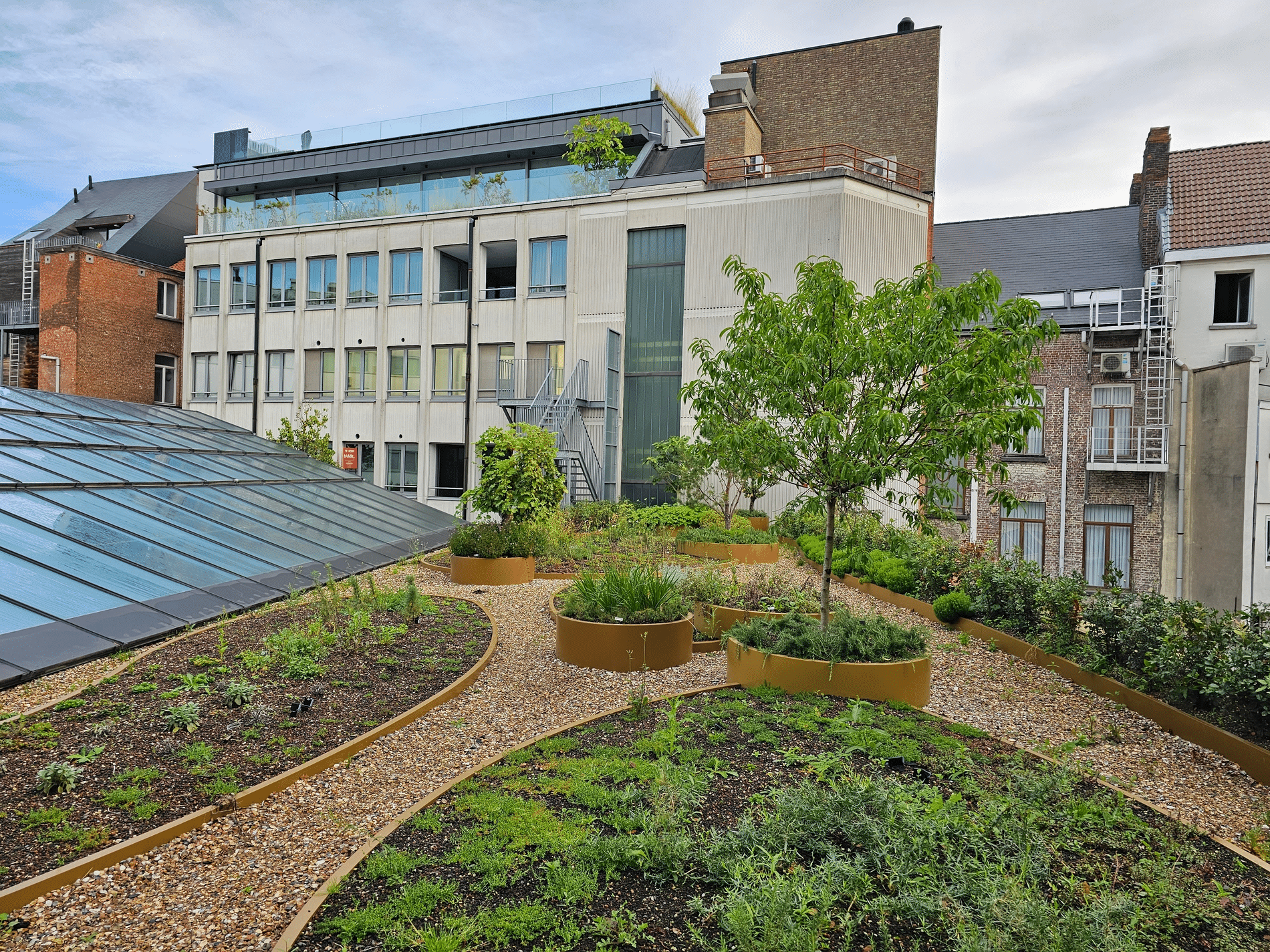
For the Yalo Urban Boutique Hotel in the centre of Ghent, Canopy created a rooftop garden that acts as a green extension of the hotel's hospitality concept. The project focuses on the quality of the stay and the overall experience within a compact urban context, using the roof as a garden, a meeting place and a visual asset for guests and visitors.
The roof garden was landscaped with edible greenery, trees and bespoke elements that enhance the character of the rooftop while remaining functional in use. Within this project, FURNS supplied all the bespoke aluminium work. This includes both the round planters and the rounded retaining walls that define the various zones on the roof and structure the greenery. All elements were finished with a pearl gold coating, making them match the hotel's distinct and luxurious appearance.
The bespoke elements form the backbone of the greenery concept and largely determine the appearance of the roof garden. They create a clear spatial layout, provide space for trees and planting, and contribute to the aesthetic quality of the roof garden. The project shows how custom aluminium in an urban roof garden can be not only functional, but also visually defining.
Ekopak Sustainable Water, Deinze
On the De Prijkels business park in Deinze, Ekopak Sustainable Water has realised a new head office in which water, energy and landscape come together integrally. The project, designed by Vandriessche Architecten, comprises a production hall of approximately 10,500 square metres and a circular office building of about 5,000 square metres, embedded in a green triangle on the south side of the site. The building has been conceived as a future-oriented and largely self-sufficient entity, with rainwater harvesting, water reuse, geothermal energy and solar panels among the permanent features of the design.
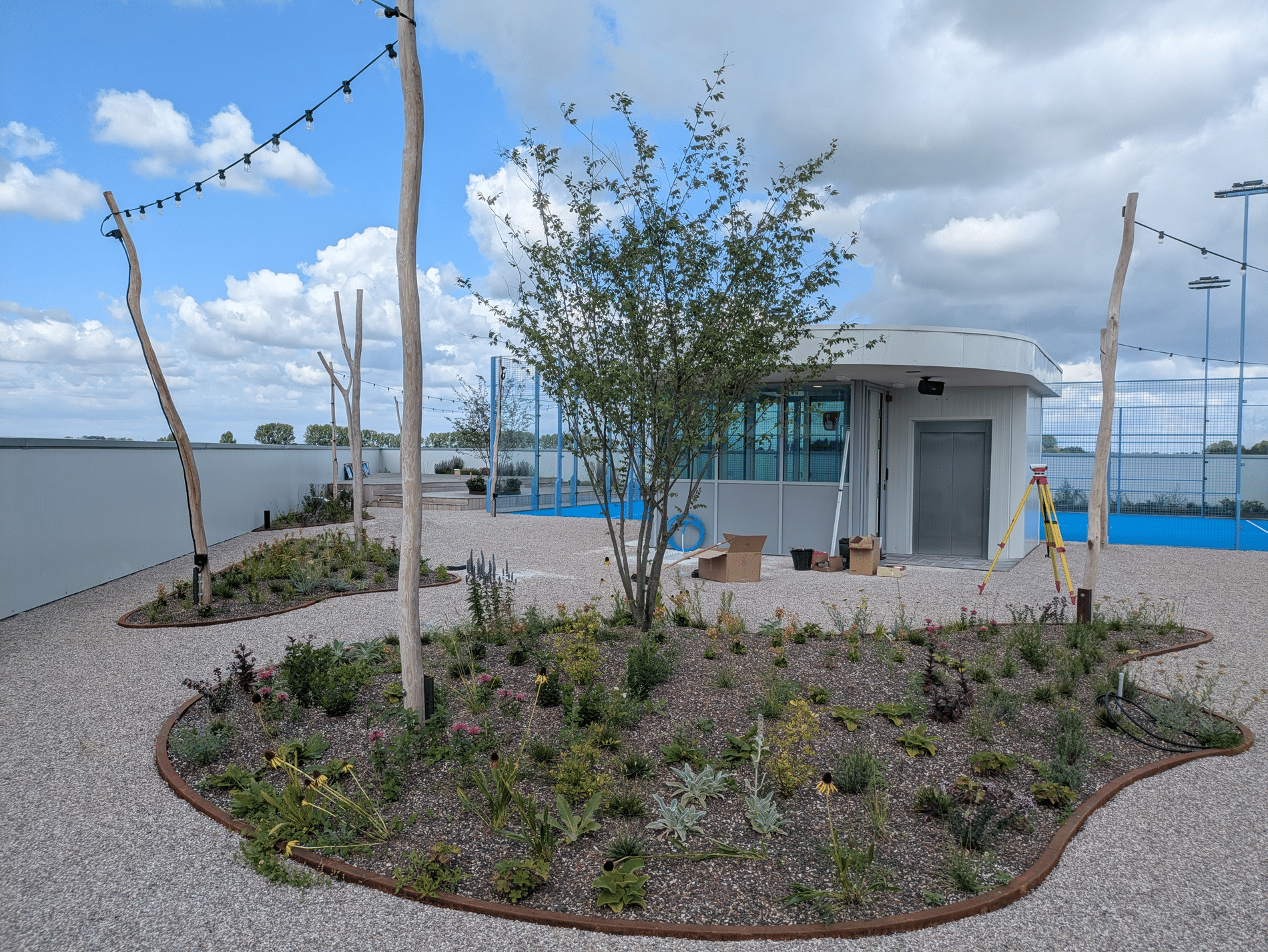
Commissioned by Algemene Bouw Maes nv, Canopy created a multifunctional climate roof that makes the project's sustainability ambitions both visible and functional. The intensive roof garden of approximately 900 square metres combines water storage, biodiversity and amenity value for employees, featuring a rooftop bar and a padel court, among other amenities. The roof is constructed using the retention system from Optigrün Benelux and, with a buffer capacity of 71 litres per square metre, can hold a total of approximately 63,900 litres of rainwater. An integrated float system ensures that the vegetation receives sufficient water even during dry periods.
As part of this project, FURNS supplied all the bespoke elements for the roof and the outdoor space. These include planters and retaining walls made of Corten steel, complemented by wooden benches that enhance the roof’s function as a recreational space. The combination of robust steel and warm wood complements the building’s industrial character and ensures a sustainable, low-maintenance design. As such, the bespoke elements form an essential part of the green roof: they organise the vegetation, contribute to water retention and make the roof genuinely usable as a recreational space.